Through the afternoon and evening, large-scale subsidence associated with the North Pacific High maintains a warm, dry cap aloft, adiabatically reinforcing the inversion that sits above the cool marine layer at the coast. This subsidence-capped marine boundary layer is a hallmark of the Bay Area’s summer climate, with marine stratus and fog waxing and waning as the daily wind/pressure cycle strengthens onshore flow by day, clears back toward the coast in the afternoon, and rebuilds overnight into early morning. Similar eastern-boundary-current settings show the same physics: the camanchaca/garúa of Peru–Chile under the Humboldt Current, the Namib fog sustained by the Benguela Current, and summer stratocumulus along Portugal–Morocco under the Azores High—all echo the Bay’s Gain-of-Fog across their own terrain and seas.
In spring and summer, marine stratus—often thickening into fog at the coast—regularly blankets the shoreline, especially near the Golden Gate and outer coast. Along Northern California, summer fog frequency is typically ~40–44% of hours near coastal sites. This regime is sustained by cold, upwelled waters of the California Current (about 52–55 °F / 11–13 °C in summer) that cool and stabilize the marine boundary layer, while inland heating establishes pressure gradients that draw the moist layer ashore. The cycle tends to peak overnight and toward early morning, clear back to the coast during the afternoon, and redevelop offshore in the evening, priming the next day’s return.
The San Francisco fog has shaped the city’s history and identity for centuries. Drake sailed by the entrance to San Francisco Bay in 1579, but the harbor remained undiscovered—likely concealed by summer fog and its narrow opening. Early Spanish explorers in the 18th century likewise recorded the fog as both a navigational hazard and a natural protector, cloaking the shoreline and adding to its mystique. On clearer days, those same explorers saw the jagged granite peaks rising offshore and named them Los Farallones—“the cliffs” or “claws”—for their sharp, claw-like silhouettes emerging from the fog. Over time, the fog became woven into local art, literature, and folklore, while also shaping how people live and dress outdoors. Windbreakers, gaiters, and extras combined with layering, help maintain body temperature in homeostasis with the fog and within the various microclimates that shift throughout the day, requiring adjustment as you 'shift in gear'. In recent decades, the city’s cultural embrace of this weather phenomenon has reflected not only its role in cooling summers but also how it challenges daily routines, defining San Francisco’s distinctive outdoor summer experience.
We have lived in and around the Bay Area for thousands of years, in unison with the recognizable estuarine environment of the modern San Francisco Bay, which took shape only around 10,000–11,000 years ago as rising seas after the last Ice Age flooded ancient river valleys. Life persisted in the fog-formed ecosystems of the area, following essentially the same daily patterns of summer fog that still occur today—rolling in by evening, spreading overnight, and retreating under the afternoon sun, though its frequency and inland reach have varied over time. Paleoecological studies confirm that fog has long been a crucial moisture source for coastal ecosystems. Measurements of stable isotopes in redwood growth rings show that fog-derived water contributes significantly to tree physiology during the summer dry season. These findings align with long-term observations showing that fog drip provides 20–45% of the total water budget in redwood stands, underscoring how this process has sustained both natural ecosystems and, indirectly, all who depended on them.
Late afternoon into evening, onshore winds often help low clouds/fog re-form offshore and push inland through the Golden Gate. Coverage commonly envelops western San Francisco (Sunset and Richmond) and, on many days, extends across the Bay to the East Bay shoreline and up the Berkeley/Oakland hills by evening or overnight. The inland reach ranges from just a few miles to across the Bay, depending on marine-layer depth and the pressure/wind setup that day.
During daylight, the marine layer’s inland reach is usually limited because the layer is often shallow (<~1,000 ft) by afternoon and blocked by coastal hills/ridges; meanwhile, daytime heating over land mixes and evaporates the cloud deck, driving the familiar afternoon clearing back toward the coast. The result is sharp microclimates—clear a few miles inland while thick stratus hugs the coast. East of the Oakland/Berkeley hills (crest ~1,700+ ft), regular, persistent coastal fog is uncommon; deeper layers and gap flows can still carry low clouds inland later in the day or overnight, especially through the Carquinez Strait.
At night, marine fog frequently lingers and can continue drifting farther inland—primarily through the Golden Gate—often reaching its maximum extent toward dawn, then retreating coastward through late morning to midday. North of the Gate, the canopy spreads into Marin lowlands and valleys, pooling against coastal ridges and sliding inland via the Petaluma Gap toward San Rafael and Napa. Under these overnight conditions, a stable subsidence inversion suppresses vertical mixing, allowing the deck to fill in and thicken: along the immediate coast the cloud base lowers to a few hundred feet or the surface (fog), while just inland it presents as stratus with ~800–1,200 ft ceilings. Inland reach commonly extends ~10–15 miles, and in stronger pushes 20–40 miles into Napa/Sonoma or even toward the interior via the Carquinez Strait. Laterally, the canopy can span Bay margins—from San Francisco to Oakland and down toward Mountain View—before thinning into patchy decks toward the South Bay and Delta. This nocturnal marine cover tempers overnight temperatures and moistens coastal ecosystems, shaping the region’s microclimates.
This fog-driven microclimate yields remarkably sharp temperature contrasts: coastal and near-coastal zones stay cool and cloudy while interior valleys (e.g., San Jose, Fremont, Concord) commonly run ~15–25 °F warmer—often 20 °F (≈11 °C) or more on typical summer days. These strong atmospheric and terrain-driven gradients define the Bay Area’s distinct climatic zones, steering local weather and ecology—coastal cloud cover moderates temperatures, raises humidity, and even supplies water to ecosystems such as redwood forests—while also shaping human activities from daily clothing choices to energy use.
The dense summer fog over the Bay Area isn’t merely weather—it’s the visible edge of a coupled ocean–atmosphere system: cold, upwelled water in the California Current, subsidence and onshore pressure gradients tied to the North Pacific High, gap-and-ridge topography along the coast, and the diurnal cycle of daytime solar heating and nighttime cooling. Its reach has shaped microclimates, ecosystems, and human choices, and it’s become part of the region’s cultural identity.

FOG
ENTER
⟳
THE°NEXT
CAST
♊︎ ☼ ⟳rb hPa
🅐 Day’s ATMP–DEWP spread: 0.5 °F ≈
🅐 Refusal to burn off beneath the arc ≈
🅐 Lifting Condensation Level (LCL) held to near-skimming sea ≈
🅐 Floor of fractional feelers ≈
◯
Fog Stability Index (FSI)
FSI = 2(0.2) + 2(−16) + 30
= 0.4 − 32 + 30
= −1.6
FSI = −1.6 → Fog-forming regime: saturation below inversion.
Pacific High–capped marine layer (ML) — stable, moist, shallow.
• WTMP : 52 °F (sea-surface temperature)
• ATMP : 54 °F (air temperature)
• DEWP : 53.5 °F (dew point)
• RH : 98 % (relative humidity — near saturation)
• Pressure : 30.03 in Hg (steady; subsiding Pacific High)
• Wind Dir : NNW (325°) (coastal upwelling regime)
• Wind Spd : 17–22 kt (moderate mixing, advection strength)
• Inversion Base : 1/4 mi above ground
• Marine Layer [ML] Depth : ~1/8 mi
• Visibility : ~1/4 mi
◯
▼
FORCE
▲
│
│
│
🜁 Fog
🜂 Ocean
🜃 Ground
│
│
│
▼
FIELD
▲
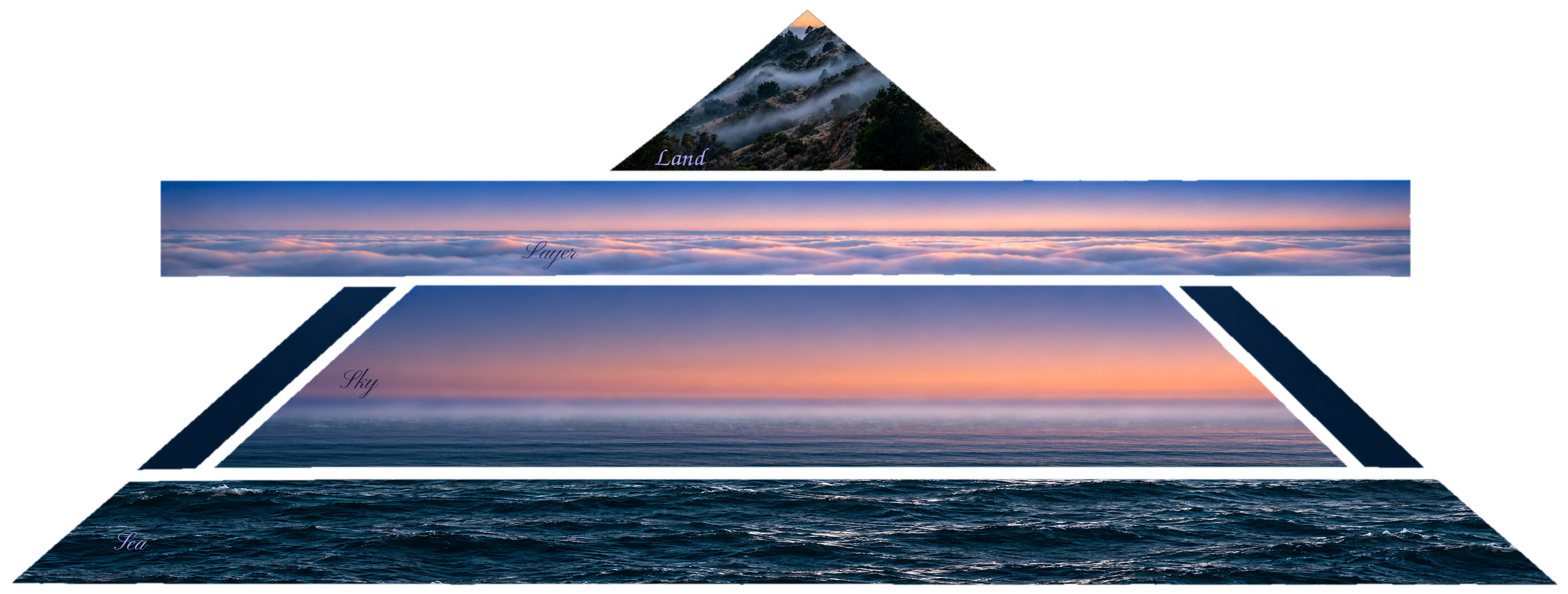
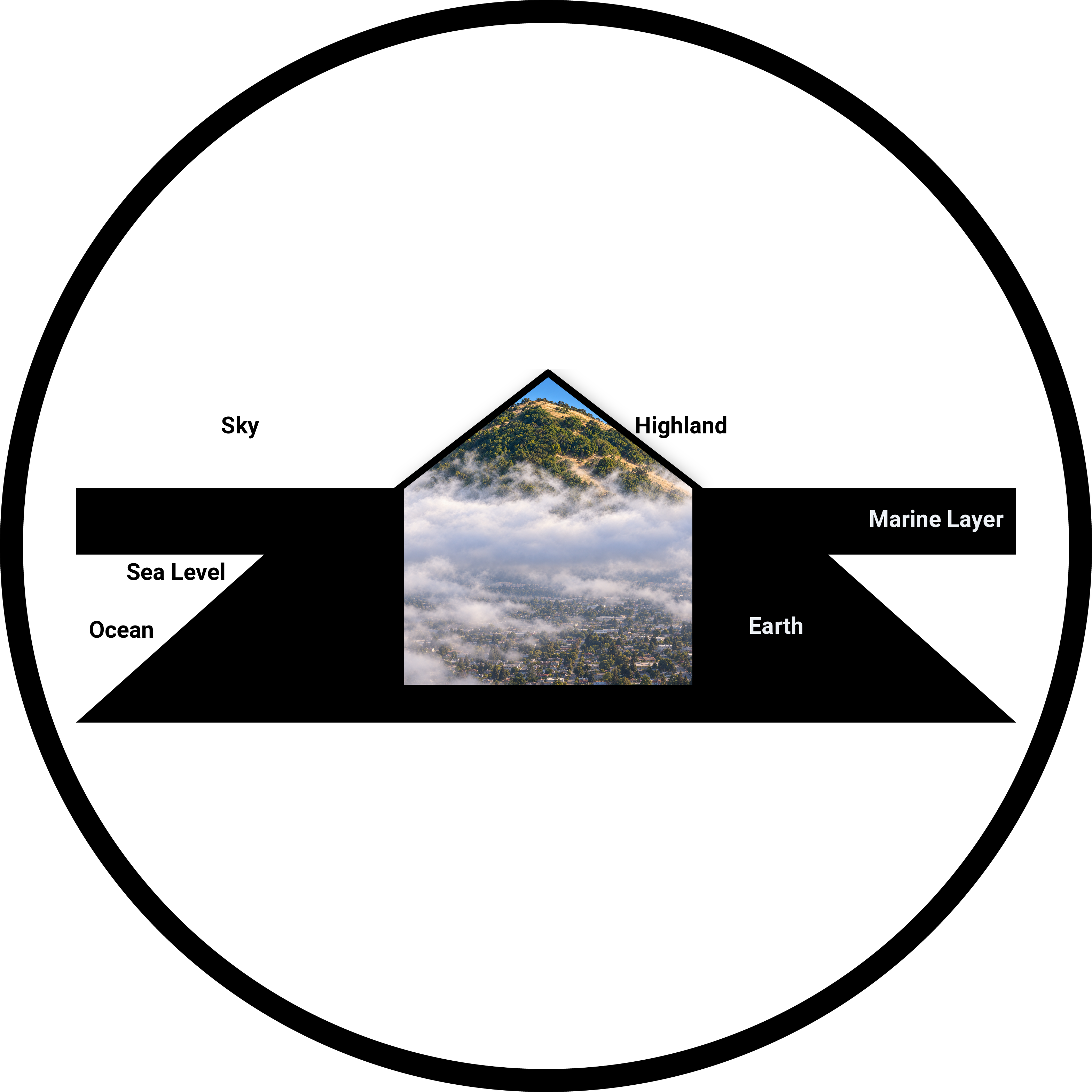
SKY ▸ HIGHLAND ▸ MARINE LAYER
Indwelling, vibrating molecules and amorphous atoms,
Sun in—so arise!
Suscitated by superadiabatic street heat here at the soles,
Shaking to the max, rising ~¾ mile—bay-delayed relay,
Sun-beam heats into invitations coarcted iris—wake the diurnalized day,
Dialed in hosts of hidden crux—hot/cold—east/west—tap,
Insolation fierce, hydrotic throes of sensorium.
Summer hales to ΔP—Bft 5 surf-hit—Pacific vest,
Eve @ coast—lost, logic-gated—
Orientate into vernal equinox, τέχνη
⟁round-display parture ≈
⟁ veered FOG pours eastward ≈
⟁drift beneath inversion’s ceiling ≈
⟁ fluidal vectoring through counterposed gradients ≈
⟁wash upon the heated column ≈
⟁ matter-cooled all the better ≈
⟁eriform vector of physical law ≈
⟁ surge shaped by gradient force ≈
⟁float in recursive apposition ≈
⟁ fog banks a quaking fault-vault ≈
⟁poria’s air exsolves in U ≈
OCEAN ▸ SEA-LEVEL ▸ LAND
To the seaward Pacific, a carbonaceous-chondrite marina—
Fog—outtake–outset,
Eye-mirroring the reflection of fog—seas ether-entrained into nocturned stratus,
Compounded to limit=admit–enrich–switch–pitch–ignite→flight—drift—lift—shift—
a shear–sheer circuitry-latticed vehicle,
f(T, q, U, SST, HMBL, ΔTinv),
[Harvests’ Floor → Scar-fog → Next-Point → Fog-bank → Narrowscape → Jut → afield]
Vehicling into instantaneous flux-bearing exchange regimes,
Colder now in the apparent wind wreathed across sea and sand,
Manuling automatic within the vehicular air-share—
◯
Advent of microphysical drivers—accretion into the layered pour.
◆ ABOVE — SUBSIDENCE CONTROL LAYER
In the lower free troposphere,
descending dry air from the North Pacific High
warms adiabatically while sinking,
feeding the pressure ridge that sustains the marine inversion
and regulating the depth of the coastal cloud field
◆ UPPER — CTEZ (Cloud-Top Entrainment Zone)
At the marine layer–free-troposphere boundary,
subsiding warm air caps the moist deck.
Solar heating above and infrared cooling below
sustain the inversion while dry air entrains downward,
sharpening stability and maintaining a coherent coastal stratus field.
◆ MID-DECK — TURBULENT STRATUS LAYER
Within the saturated layer,
droplets approach adiabatic equilibrium.
Cloud-top radiative cooling drives weak turbulence,
circulating moisture and liquid water
through a shallow, mildly stable stratus deck.
◆ TRANSITION — COALESCENCE / DRIZZLE ZONE
Within the lower cloud body,
droplet collisions promote coalescence.
Enlarged droplets begin a slow gravitational settling,
forming intermittent faced drizzle
that redistributes liquid water through the fog column.
◆ LOWER — SURFACE SKIN
Along the air–ocean interface,
sea-salt aerosols seed condensation
as cold SSTs cool surface air toward saturation.
The LCL descends toward the surface beneath the inversion,
while the solar arc seasonally approaches its zenith.
◯
Weather disappears for awhile, matrixed within a spectrum of perception, a shallow diurnal loop;
air asks what must be within the august film,
drawn through a cincture of aero-hydro-land canvas,
pinned by an offshoot of the subsidence wing
of the North Pacific High,
aligned with the low-level California jet,
a northwesterly strain beneath inversion’s tiara.
Microclimatology upheld: a fog-front firm to wet sync,
as unheld: a face afoot, onto dry-ignite,
taken to coast-quest, innate in the bite
of fog-potion #3.
June — Upper humid at sixty.
July — Mid-stratus near ninety.
August — Lower escape to sea.
Kinetic chills of another gofdam day prevail—
Now see it fleet weak in heat.
Mediated: @ Face 93 in a 98.6° Functional Forward FFF—
Too—one hundred present % in the nephelo-blackened sea.
Kairos emanateth to sunning spots—Too—
Circulating in its ℓ-th touch.
Abounding as coalescence envelops—داخل.
Tellingly the Entrained Circle of GOF parleyed to the Entranc’d.
The subjects in Shield-Effectus FOG abideth.
Focusing-On-Go.
Flow-Of-Gases.
Full-On-Guard.
Frame-Of-Go.
Field-Of-Games.
Feel-Of-Going!
Too—mired deep in yestereves ocean mass.
🜁 Envelope Coupling (Σsens ↔) 🜄
🜄 Cope’s Percentage (Fr ≳ 1) 🜁
Out it seams—ontically subsiding in conceptions of efflux and exchange O’s.
Fast! forfend—formatted for fog—
Frigoreceptor fractality—frayed fields flowing forward—frontogenesis focused flux.
Figurae free-fabricating formulae—fluctuation flower.
Enter its penetralia—Grith of Fog—FLTFOGMASKGRU-PAC.
Interoexteroproprionociception.
CN-V: clad in thermal order—gradated to a fine-tuned state,
atmospheric equations resolve as microclimates,
thermal’d through gravitic gradients,
pressure-fed, picturesque—scaled to an early nightpiece,
raised on ancient ocean—clouded days of perpetual waves,
its lineage held in intervening evaporain,
omnipresence clouds the self-mixing gas,
a tableau-hap bearing down
in sky’s surmise,
beneath the PSI-pressed ceiling,
an omened, breathing solar tap,
out over et onward—oxygenases in catalytic passage.
Absorptivity draws the cooling inhale–exhalation,
Ataraxis equipoised through obnubilation,
🜁 conditioned in a radiative, steadied balance,
keyed to homeostatic mechanisms,
in motoric egress U’ll seek, traded to traipse into utility.
Five hundred watts—heat, fuel, oxygen turned—cyclolithic.
All herald the north-force of ocean-source—in a field of plexus-stacked curations,
low-laved anticyclonic ocean—the [H₂O] NP Gyre;
high-loft anticyclonic sky—the [N₂·O₂·Ar·CO₂] NP High—
in role for versions, ranging inland toward the time line,
an overtop held steady—the terra–mare aer-charmed visage,
capped beneath the Pacific Subsidence Inversion [PSI].
Foggier in 55–60 °F—in an unguarded moment before the truss over barefacedness,
raving from subsea toward acclivities’ greige lair after the Trilateral Colloidilation,
intersegmental to intracellular—set upon the pHz frequency (10⁻¹²) of 2 Oceans:
hydrospheric and atmospheric—Ætions of Enterfog,
echoing into ubiety, impictured in divergence and delivery,
made to stage, lingering, foreordained into gloam,
foreign gang-of-fog, sphered upon a calefactory core—
Verticity.
◯
Sky to Street Vertical Profile
(Arranged from Highest to Lowest)
THE FIRMAMENT (Cosmic Realms)
1. Beyond observable universe
2. Observable universe boundary
3. Cosmic voids
4. Cosmic web
5. Intergalactic medium
6. Interstellar medium
7. Heliosphere
8. Interplanetary space
UPPER ATMOSPHERE (Exo- to Strat-)
9. Exosphere
10. Thermosphere
11. Mesopause
12. Mesosphere
13. Stratosphere
TROPOSPHERE & WEATHER LAYERS (Sky to Fog)
14. Tropopause — ~5.70–7.60 mi (≈ 30,000–40,000 ft / 9.1–12.2 km) — [Troposphere ceiling]
• Sharp inversion marking the upper boundary of the troposphere.
15. Mid- & upper troposphere — ~1.10–5.70 mi (≈ 6,000–30,000 ft / 1.8–9.1 km) — [Troposphere]
• Dry, fast-moving air; jet streams and frontal systems.
16. Free troposphere [FT] — 0.38–1.10 mi (≈ 2,000–6,000 ft / 0.6–1.8 km) — [Troposphere]
• Subsiding clear air from the North Pacific High, 70s–80s °F.
17. PSI lid [Pacific Subsidence Inversion] — 0.26–0.44 mi (≈ 1,400–2,300 ft / 0.42–0.70 km) — [Troposphere]
• Warm, dry cap sealing humidity beneath; inversion top.
18. Top of marine layer — 0.26–0.44 mi (≈ 1,400–2,300 ft / 0.42–0.70 km) — [Troposphere]
• Upper boundary of fog and onshore circulation, pressed beneath the PSI.
19. Marine layer depth [ML] — 0.19–0.30 mi (≈ 1,000–1,600 ft / 0.30–0.49 km) — [Troposphere]
• Cool, moist fog body connecting ocean, land, and atmosphere.
20. Fog base — 0.08–0.13 mi (≈ 400–700 ft / 0.12–0.21 km) — [Troposphere]
• Lowest visible edge; surface-based cloud deck along coasts and valleys.
21. Fog to ground — 0.00–0.08 mi (≈ 0–400 ft / 0.00–0.12 km) — [Lower Troposphere / Surface Layer]
• Ground-contact fog; the lowest extension of tropospheric cloud,
formed when air temperature equals dew point at the surface—
visibility < ¼ mile (≈ 1,320 ft / 0.40 km), condensation directly at land or sea interface.
Order Summary (Highest → Lowest)
Beyond Observable Universe → Observable Universe Boundary → Cosmic Web →
Interstellar Medium → Heliosphere → Exosphere → Thermosphere → Mesosphere →
Stratosphere → Tropopause → Mid & Upper Troposphere → Free Troposphere [FT] →
PSI Lid → Top of Marine Layer → Marine Layer Depth → Fog Base → Fog to Ground
◯
🜃 nightside magnetotail in the pale,
as radiative cooling resets the inversion.
Enshrouded anew—Isolation’s flèche—at junctions Midst Scar.
Fog-dripping hush of advection banks, stratus-shifts sway,
upslope fractus zips along the ridge-spines,
sky awash—wind-split drizzle; fleet scud dashes,
radiation mists linger; wisps unravel.
The texture stages in winter’s chilling gauze,
ides of fog steered through the Gates of Intros,
lifting in gradient along the highland,
braiding into peripheral microclimates,
coursing into you—subterranean bidirectionally.
Cold-air drainage jars—hence, accelerant flow,
inversion pressed to the theme of portation,
nightlong mist beading from a full anyang over,
endued in a rose-window integral—
thirty miles in the radii.
High-lore of tide and motion, constitution met:
H(Uₕ, θ, q, W, L, V, τₛ, ΔTskin↔air),
Uₕ@W→shell;
(θ,q)|L↔flux;
V⊣step⊢sight;
τₛ←χ(cold·drag·wet);
ΔTskin↔air→ex ∴ regulation;
traveled—centrifuged into Gofcifica.
◯
Hadley flow—from the equator northward (ITCZ), poleward aloft,
establishes the PSI, returning down upon the East Pacific find out.
Subsiding air settles into layered poise within the North Pacific High,
warm, dry aloft—setting the inversion above the marine layer—the same cap enforcing flow,
its Δz—300–2,000′—held beneath the cap,
warming adiabatically as it descends, building up,
fortifying the hold above the sea, containing the cool marine layer,
where inland heating lowers pressure, drawing the marine layer shoreward,
upwelled waters chill surface air toward saturation—
coalescence—basal entry—fog.
Empyreal mingling follows, poised in the low-lying suspended layer—Δz ~500–2,000′—
cold marine air, too dense to rise, held beneath subsidence weight,
the lowered ceiling maintaining equilibrium,
advected in the coastal jet,
near half a mile deep—Δz,
driven alongshore and inland by pressure gradient and Coriolis.
◯
In early evening, beneath summer’s Pacific High,
oceanic air impresses down to point-U,
in fog-cycles to the mouth,
of advection → motion, ocean, sun in return,
entry taking launch, land-spring motility given,
rampart shoreline in cosmolatry of polar opposites,
indivisible designs in conflux.
Fog radiating chilled charge through bare-summer—beware;
surface air falling to the upper-50s °F, yet pinned beneath skies
already 10° warmer above—not cooler—
coastal landforms cast in real-reel feel;
the ML pulsing down in layered oscillation,
ridges and hills half in cloud,
vehicles ghost-shifting under boulevard lights.
Just inland to east-splay highs and lows,
the PSI ladders—
lifted by interior heating and pressure gradients,
confining a thinned ML to only a few hundred feet thick,
its base ¼ mi from the ground;
brushing the hillsky in greyspraynt—suspended stone-cool cover,
with surface temps fair in the L60s.
Adieu the ML fluxion—to the low voes and ria-lands of mid-inland;
the PSI lifts higher—to thermal temper fueling,
leaving but a shallow trace downpoised with the weight;
hills drift, hazed in ocean’s faint scattered light.
Deeper into the parched interior vales and rolling expanse,
the ML thins toward vanishing—sun-bleached fulgent desiccation,
until the inversion loosens its grasp—dissolving as the clime climbs.
Go thy-est again, where thermolabile gradients step temps
along the horizontal, as the free troposphere grades the vertical.
≈ Passage ≈
KSFO 282353Z 28008KT 5SM PRFG VCFG E SCT020 OVC015 15/14 A3009 RMK HILLS OBSC E
Rain closes to basin return—completion in hydrologic return.
Aqu-air tends to wind—biosignature waves in the wind—
The marine layer rose @ sea—the heavens stound,
90° along the coastal strip, NNW (337.5° → 157.5°), alongshore,
drapeshifting to points of convergence models,
turning on Ekman Drive at the Coriolis turn,
shunting surface waters offshore
across the continental shelf,
colder, nutrient-rich layers rise to fill the void,
cooling marine air to near saturation,
a surface-to-air affair, condensate cast on aerosols,
ocean strata and air converge at rore,
dew-roar ignition as sea and sky angle into city.
Northwest draw links valleys into hiding-seeks,
the upper-tropospheric jet rides six to eight miles high,
shaped by a North Earth tilted toward solstice;
the North Pacific High steers the swirl and seal along the margin,
driving inversion scenes coastward to host the hide & bide,
sliding beneath the magic foggiest ride,
threading corridors in film, fill, and framework—superarrivals
in triplicate intricacy, fillip of quintessence,
breaking Mavericks QR-code,
venting through fog-belt redwoods ahead,
inland heat’s flick of the switch [ON]/OFF,
fascinating frontalities cryptic script again.
◯
≋Air≋ seeded, Forefront Formation Formulae:
into dislocating 🜁⬊╱╲⬋🜂 met,
साँस on chilled cheeks, face-ceptors bare,
startling unmasked AUVs.
Pacific frigorific—surprise.
Enterfog lungs, Oceaterra fog,
into ~112 / 72 mmHg circuits that circumvolve U! in fog-event-the-core—
Flow-of-Gases: (O₂ IN · CO₂ OUT / Air) — ~760 mmHg,
through micropore-secreted gateways.
Bewind among Boatmen,
and ⇡🚲🚶 — designated, combined as [AUVs],
Arise! U Vehicle™ ⚖︎ < 65 lbs —
raised to GPS lines, dropped to wind,
propulse lane ON ≋ destination (un)known.
To parked-OFF, secured, poised,
for another lay of land / ocean sensed.
To return anew—sensorimotor sent,
carried off to another instance,
vitalic formulae: a sensorium send-off.
Foot-Out · Take-Out : Motor-Combiners –
Wheels 🛞 & Bearings ⚙️ : Hub Assembly –
Arise-⇡ Utility-🛹 Vehicle-🏃 : FOTOmachines –
Amplifying the apparent-wind, vehicling through onshore microclimates,
realized in flux and the spired kinetics of fog-gof,
wrought from the inside out, derived from the drive.
A-go, aglow—borne of inspiration,
pressure sets the pulmonary grasp
to sate the gasp: a tableau of Enterfog.
Torque-sensors multiplied, focusing on outdoor gusts,
motor volts call the oxygen draw,
N₂ steadies the breath,
CO₂ tithed to wind,
venting in lung–blood synthesis.
◯
The G.O.F. season is F.O.G.
Gain-Of-Fog banks.
Bifurcated at B.C., the California Current
Skirts Farallon scars, inspirited to the 🜁 conveyor,
upwelled Panthalassa coolant intels the
translation of coastal gradients,
advecting along San Andreas,
attracting aim,
incenting vantage point,
weaving pyramidal spells
through geodesic disclose,
running at Golden Gate rate.
While crust-illumed
interior’s infrashot 🜁
holds a foothold,
to birrs chill,
to
☉
For U, fog-rates stir in the foreground,
the ML stratification deepens...
pooling in hollows...
its crown—the warm cap—pressing...
on the 600 ft thick, fret-bound layer,
in subsiding trawls and hauls,
turning hover-pass into roller-coaster.
As the inland thermal trough sheds its gradients,
winds wend farther inland—slope by tract, block by sock,
advancing through the Central Elements Grid [CEG].
No longer rising,
air parcels settle,
thermal mixing stops,
a stillness takes hold.
Fog fully horizoned,
In a deep GOFrific
LOWcific SKYline.
◯
Another setting to ideate the logic of wind-denned,
fog to fog, in locomotion-mixed passage,
borne by the imaginengine.
ON://INTERLACE→COOL,
sheened with dipalmitoylphosphatidylcholine,
circulation filtered — motion, renewal,
across the span of the membrane’s clover states.
In quietistic surrealism—scarfed to the 🌞,
an 👁 above clouding clouds, tuned to sea change,
April showers bring May flowers, panæsthesia—
modulating through I/O’s brief blooms,
where inspiration opens the astounding stage.
F…
O…
G...
◯
The PSI—an inversion band aloft, Δz on the order of a few hundred feet—
caps and couples with the layer in NNW flow, thickened to near ½ mile,
suppressing convection and holding the sky beneath its stable frame.
Yet in collapse phase—when the layer slims to scarcely 300 feet,
it no longer sustains a continuous stratus deck
but fractures into advected fog-banks and scattered breaks,
raptly shown into curtained panes,
moving pictures a quarter mile away,
while here stellar colors see in skyshift graphic,
apostles forecast to the heliosphere’s aware.
Dive lower, condensation energy gathers in latent whelm,
the city dammed to air in perpetual leaves.
And when you step inside, the fog’s already out—
Pacific proximity-pressed to scar fog,
deep-seated, to the coldest winter, copy-pasted into summer.
As the sun still shines on and on,
2025 PN₇—Earth’s quasi-shadow—
in the astir fabric of the lee,
cloudflare driven upslope, Terres Hautes alight.
Towards the dawn of machina click,
10²⁴ stars fall to breathe per high-sky %,
far fusion at bay, its nearness transarterial,
scène in cycles against the waves,
captured in CPW.
◯
─────────────────────────────────────
⟦ Form 🜃 ⇄ Flow 🜄 ⇄ Flux 🜁 ⟧
▸ FENCE ID :: SCARFOG® <> BRAND ROSE 🜁T SEA <>
▸ FACE_CLASP :: FAST / SCARF-OPTIONAL-GAITER / FACEMASK – LOWER
▸ PROTOCOL :: (–) FULL-ON-GUARD (+) GAIN-OF-FUNCTION
▸ VIEW-OF-PASSAGE :: IMAGE_FAÇADE_HI-ART
─────────────────────────────────────
⟦ FRAME-OF-GEOAEROGRAPHY ⟧
▸ HORIZON :: TILTED–PACIFIC–CHILLED_54°-EQUINOX-54°
▸ SCUD :: FRONT–OCEAN–GUST_BANK
▸ PANORAMAS :: FLOWSTATE–OF–GRADE
▸ INFRARED :: ATTENUATED_(CERT)
─────────────────────────────────────
⟦ FACILITATION–OF–GAITER ⟧
▸ FERVOR–OF–THE–VEHICLE :: PRESSURED–WEATHERED–VESTURED
▸ VENT–OF–PASSAGE :: FLOW–OF–GRADIENTS
▸ FRONT_IMAGE_OVERLAY :: CUSTOMIQUE–EMBLAZONED
▸ FACEFILM_THERMAL_OFFSET :: FREE–OTHER–GARB
─────────────────────────────────────
⟦ FACING–OPEN–GAUZES ⟧
▸ REAL–TIME_MODULATION :: CAST–ID–YHV 46026 18
▸ MOTIVATOR_SYNC :: FRAME–OF–GO!
▸ FULL–ON–GUARD :: WIND–UVA/UVB–ELEMENTS
▸ OCULUS_SYNC_HOLE(2) :: HISTORIC_SIGNATURE
↳ ΑἰΘΉΡ (UPPER – CELESTIAL AIR)
↳ ἈΉΡ (MIDDLE – MORTAL AIR)
↳ ἈΧΛΎΣ (LOWER – MIST / VEIL / FOG)
─────────────────────────────────────
⟦ FRIGORIFIC–OCTOBERS–GIVEN ⟧
▸ FORWARD_OF_GUARANTEE :: SUN_ANGLES–LOWER_ALEUTIAN–LOW
▸ FORECASTED_OCEANIC–GRADIENT :: SUMMER_SURGE_&_FIRST_PACIFIC–STORMS
▸ SCARFORMULATIONS :: MORE–PLYS–TO–FACE_NPH–RIDGES–AWAY–FROM–COAST
▸ N. Pacific High–EQUATORWARD/WEST–SHIFT_PSI–5500BAY-LIFT :: DIABLO WINDS
─────────────────────────────────────
⟦ FORMULATIVE–OBJECTIVE–GAIN/GUIDE ⟧
▸ FABRIC(ATION)–OPTIONS :: GALORE
▸ CONTACT–JUNCTIONS_BUILD :: FOG
▸ FAB–POINTS_INTEGRATION :: GOF
▸ IMPROVISATIONAL–CALCULUS :: FLUX–ORDERED–GRID
▸ ATMOSPHERIC–CATALOG_RELAY :: ACCESSION–SENT
─────────────────────────────────────
─────────────────────────────────────
S I G N A T U R E (–) F O G (+) C A S T ™


SCARFOG® — FACE MICROCLIMATE SCIENCE
Wind Control • Thermoregulation • Breath Comfort
1. APPARENT WIND ON THE FACE
Situation Wind you feel
------------------------------------------------
No wind, jogging 6 mph 6 mph wind on face
10 mph headwind + running 6 mph 16 mph wind
10 mph headwind + biking 18 mph 28 mph wind
Apparent Wind = Ambient Wind + Your Motion
As movement increases, wind striking the face increases.
This dramatically increases convective heat loss.
2. WHY THE FACE MATTERS
The face is one of the most thermally sensitive regions of the body.
Small changes in facial temperature can affect:
• perceived whole-body warmth
• breathing comfort
• respiratory dryness
• endurance during running or cycling
Facial skin contains dense nerve endings and blood vessels
that respond quickly to wind and temperature change.
3. THE SCARFOG® MICROCLIMATE
Without protection:
wind → skin
With a structured fast™ scarfog® sequestered gaiter:
wind → outer structure → slowed air → boundary air layer → face
This creates a small protective air chamber where:
• airflow slows
• warmth from breath stabilizes the air
• convective heat loss decreases
4. WIND REDUCTION THROUGH FABRIC
Fabric type Wind reduction
----------------------------------------------
Thin cotton ~30–40%
Fleece / knit ~40–60%
Wind-blocking fabric ~60–90%
5. BOUNDARY LAYER EFFECT
Normal condition:
wind → strips away warm air layer from skin
With it scarfog formatted:
skin → warm air film → gaiter structure → external wind
The thin warm boundary layer remains more stable,
reducing facial chill and airway irritation better.
6. PERFORMANCE BENEFIT
Cold air striking the face and airway can reduce endurance.
Moderating airflow can improve:
• breathing comfort
• perceived warmth
• respiratory moisture balance
• endurance in cold wind
7. IMPORTANT NOTE
At apparent wind speeds of 15–20 mph — common during
cycling, running, or micromobility travel — the face
can lose heat faster than bare hands.
Creating a buffer zone of air in front of the face
is therefore an effective thermoregulation strategy.
THREADS → BLOOD
Wind threads strike the front wall.
Within the chamber the boundary air holds.
The face is conditioned.
C⟳⟳l translated softly into blood.